UG
UGMEVD17.2 · BMW N55
N55
Tuner
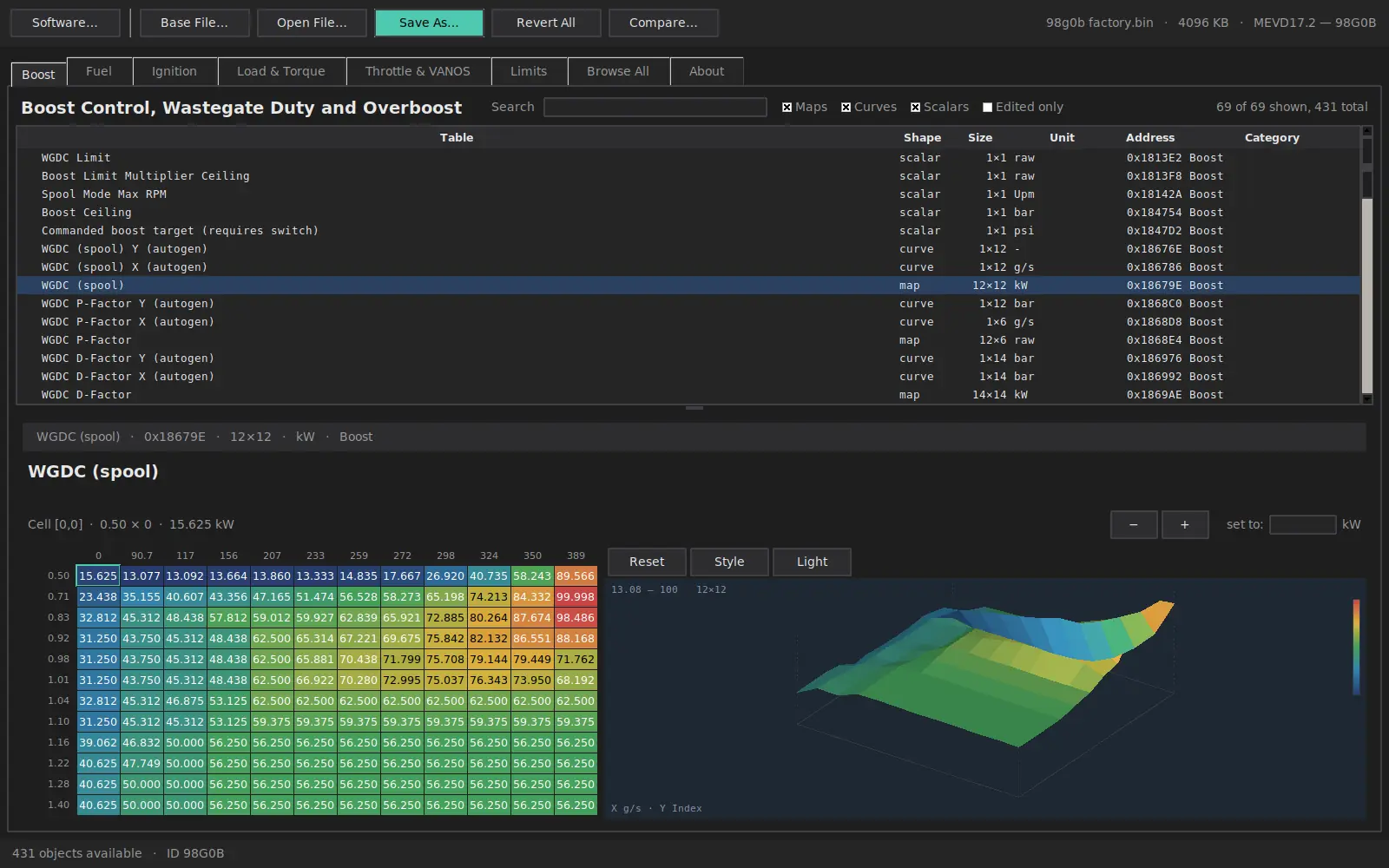
Wastegate duty against MAF and temperature, with the same map as a rotatable surface on the same colour ramp.
What you get
to work on
The tabs cover what most people came for. Everything else in the definition set is still there and still searchable.
Boost
Wastegate duty and overboost
WGDC base, spool and the PID terms, overboost duration and load adders, boost ceilings and the pressure thresholds around them.
Fuel & ignition
Timing, lambda and scaling
Main and spool timing, both fuel banks and their scalars, lambda limits, and the load-to-torque ceilings that decide how much the DME will ask for in the first place.
Diagnostics
The fault codes, named
The DTC toggles as individual controls rather than one opaque block — including one this definition set does not name, found by diffing every shipped tuned file against the factory image.
You cannot pick
the wrong one
Read the file off the car with whatever tool you already use for that, then open it. The tuner reads the DME software version out of the file and tells you which one you have — the picker at startup is a convenience, not a quiz. A file from another version warns before it opens; a file of the wrong size is refused outright. You do not need to know it in advance.
| DME software | Image | Objects | Files included |
|---|---|---|---|
| MEVD17.2 — 98G0B | 4096 KB | 431 | 1 factory + 18 tuned |
| MEVD17.2 — 9E60B | 4096 KB | 420 | 1 factory + 17 tuned |
851 objects in total — 184 maps, 574 curves, 93 scalars. Every one of them generated from the definition file and then read back out of a factory image of its own software version before it shipped: in bounds, dimensions consistent with the record layout, axes sane.
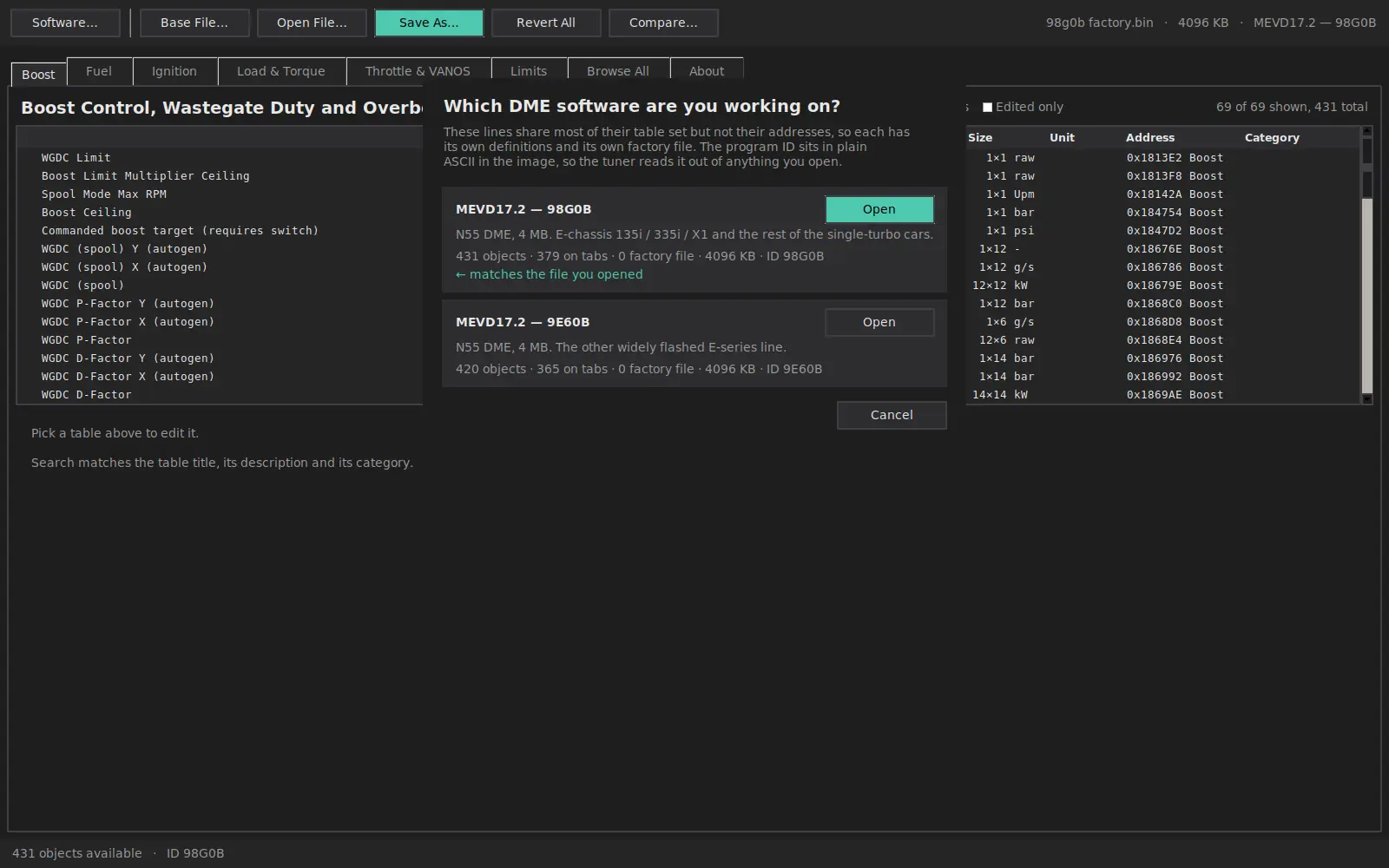
Every supported line in one build. Open a file and the tuner works out which one it is looking at.
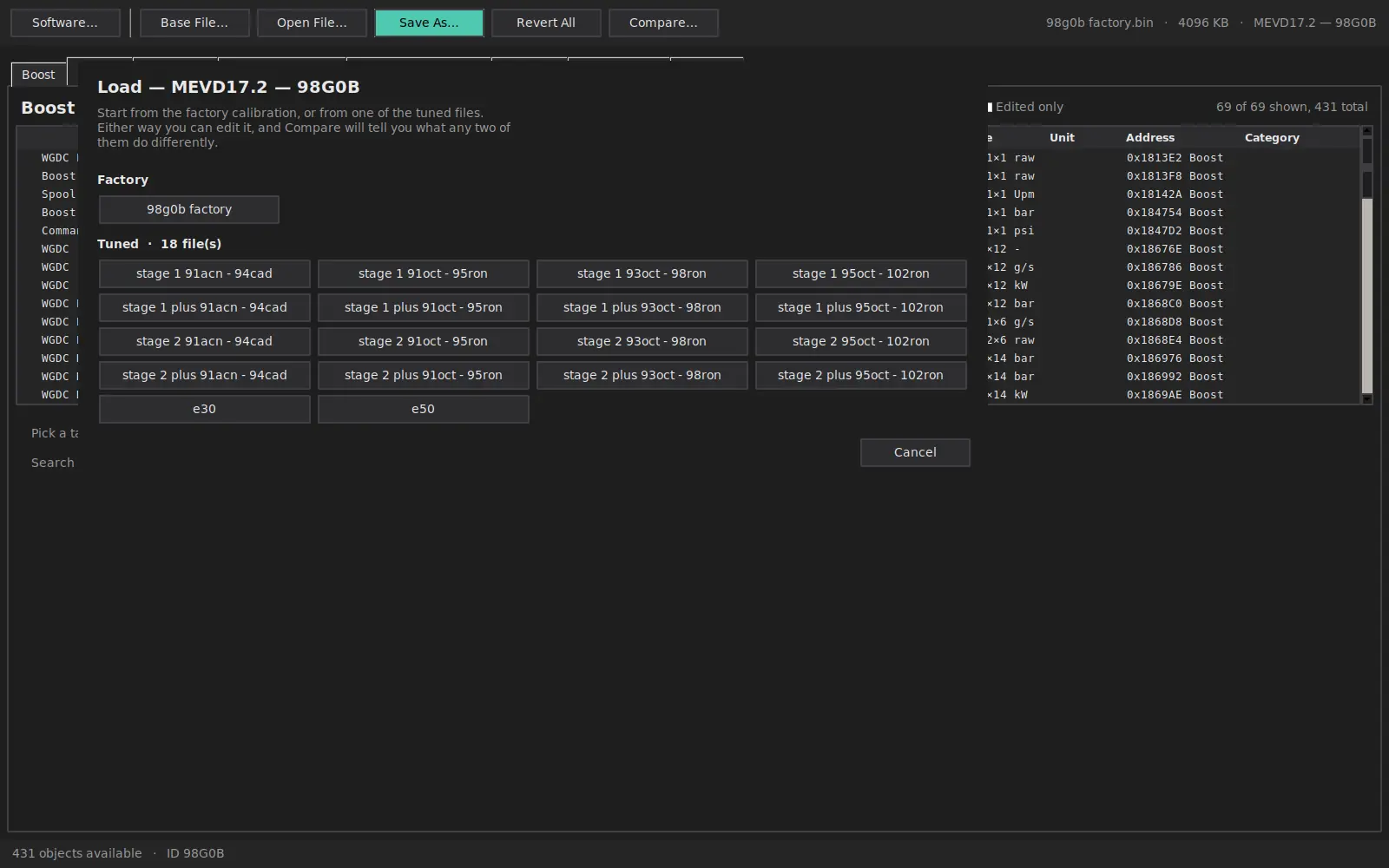
Start from the factory calibration or from one of the tuned files. Either way you can edit it, and Compare will tell you what any two of them do differently.
Round-trip
byte-identical
Read every object out of a factory file and write it straight back, and the file has to come out identical. Anything less means the tool does not fully understand something it is showing you — and an editor that quietly changes bytes it never displayed is worse than no editor. It is checked on every factory image and on the tuned files too, where values sit at the edges of their ranges far more often.
Heat-shaded grid and pop-out surface on the same ramp, so the shape of a map reads before the numbers do.
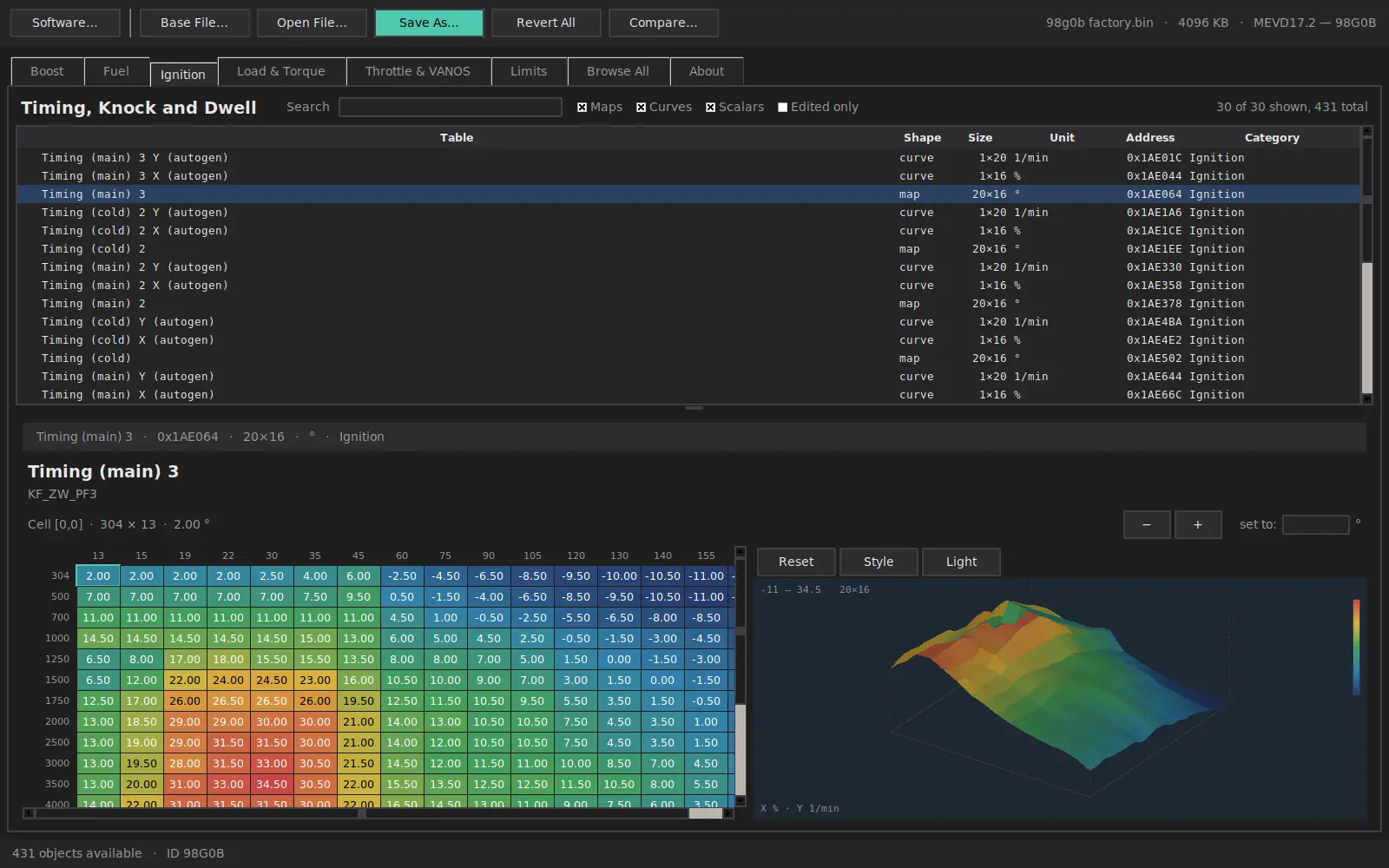
Timing against load and engine speed. Select a range and the readout gives you min, average and max across it.
Compare
two files
Diffing two calibration files byte by byte tells you nothing you can act on. Diffing them through the definitions tells you which named maps moved, how many cells, and by how much — which is how you read a tune you were handed, check your own work before it goes on the car, or see what actually separates two versions of your own file.
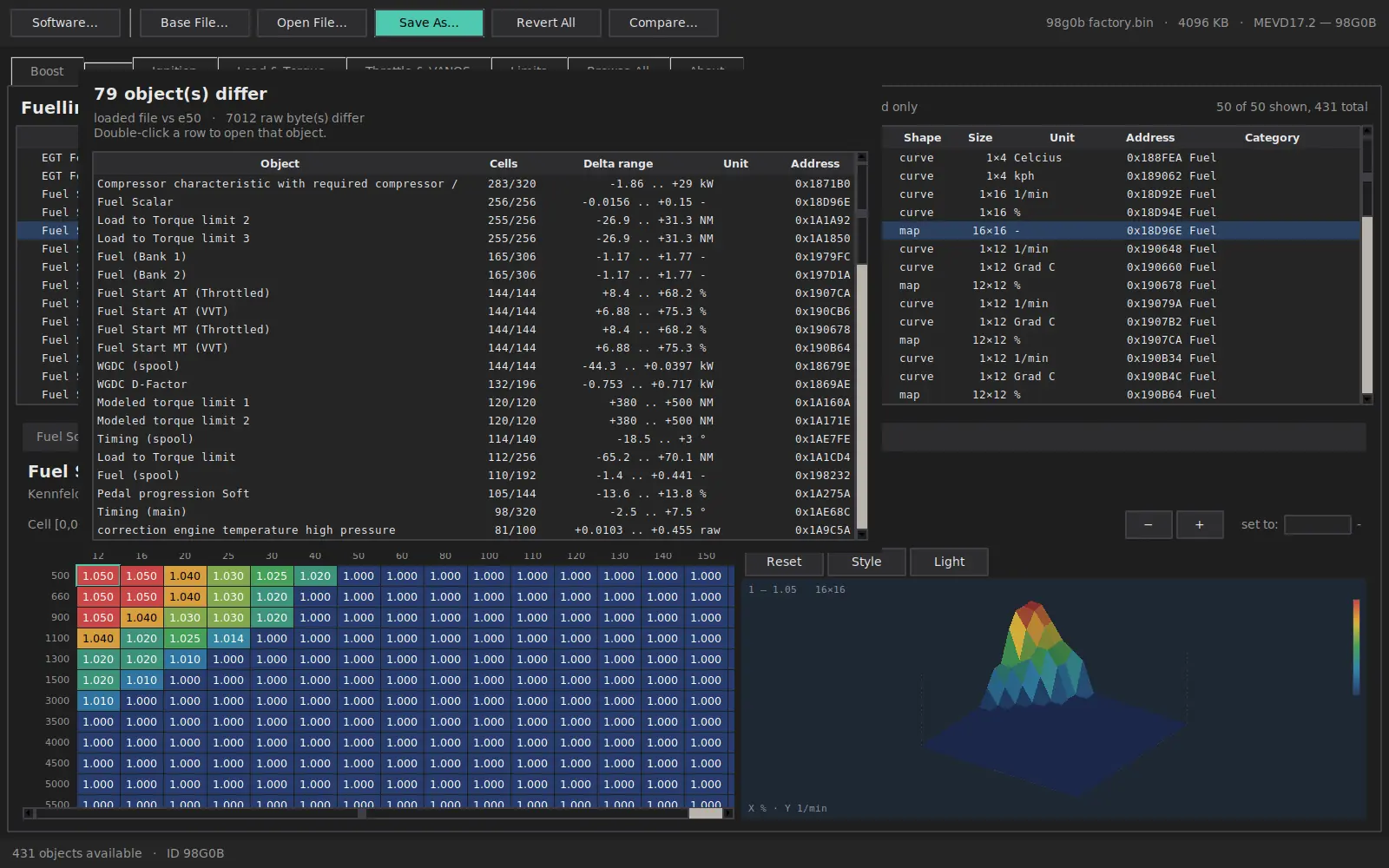
A stage 2 file against the factory one: the compressor characteristic 286 of 320 cells, load-to-torque limits at 255 of 256 each, both fuel banks, WGDC spool across all 144. Double-click a row to open that map.
Where the
definitions came from
These definitions are the community XDF packs for the N55, parsed and then checked rather than taken on faith. Every table is read back out of a factory image of its own software line before it ships. Diffing all 35 shipped tuned files against the factory images leaves 1,829 and 1,596 changed regions, and all but one land inside a defined object — the exception is a single byte that three of eighteen files touch inconsistently, and it is deliberately left undefined rather than dressed up as a control.
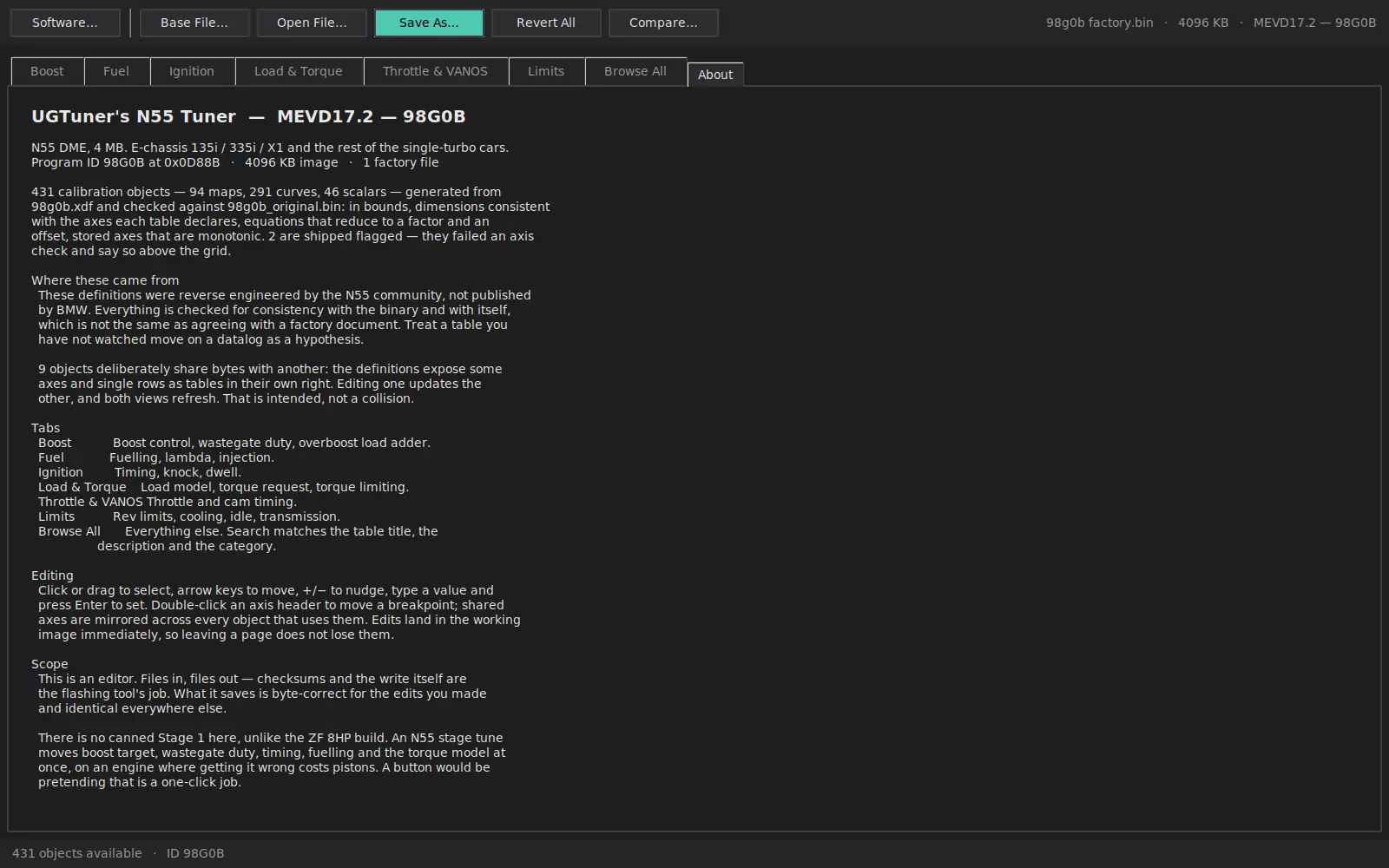
Provenance on the front page of the app: which definition file, which reference image, what was checked.
Read this first
- This is a calibration editor. It opens a calibration file, lets you change it, and saves it again. It does not read or write the DME — getting the file off the car and back on is a separate job with separate tools, and you need one already.
- Checksums are not corrected here. Whatever you use to write the file handles that, as it does today.
- Keep the untouched original. The factory file for every supported line ships with the tool, but keep your own read as well.
- Raising a torque or boost limit removes a protection the engine was given for a reason. On stock hardware there is usually nothing to gain by touching it.
- Sold for off-road and competition use. What you do with it on a road car is on you.
Buy
Sold direct, by email. Say which suite you want — UGTuner N55 — and which chassis you are on, and I will send the file and the invoice.
$350
Buy the platform once, tune as many cars as you like
- All 2 DME software versions in one build
- 2 factory and 35 tuned files included
- Compare, search across every table, pop-out 3D surfaces
- Updates and email support
Contact
Built engines and big-power cars
- Worked around what the engine actually makes
- Hardware that does not match any off-the-shelf file
- Priced on what the job actually needs
Locked to one PC, not to one car. You send a hardware ID, I send back an activation
file — no internet check, no dongle, nothing phoning home.
Not sure which DME software your car has? You do not need to be — open the file and the tuner tells you. If you would rather check first, send me the file: ugtperformanceusa@proton.me. Gearbox as well? The ZF 8HP page covers the other half of the tune.