UG
UGZF 8HP · BMW EGS
ZF 8HP
Tuner
The gearbox is the other half of the tune. Shift points, torque ceilings and clutch fill, named and scaled out of the factory A2L — four software lines in one build, every object verified against its own factory image.
UGTuner ZF 8HP · Windows 10 / 11 · 57,090 verified objects · 21 stock files included
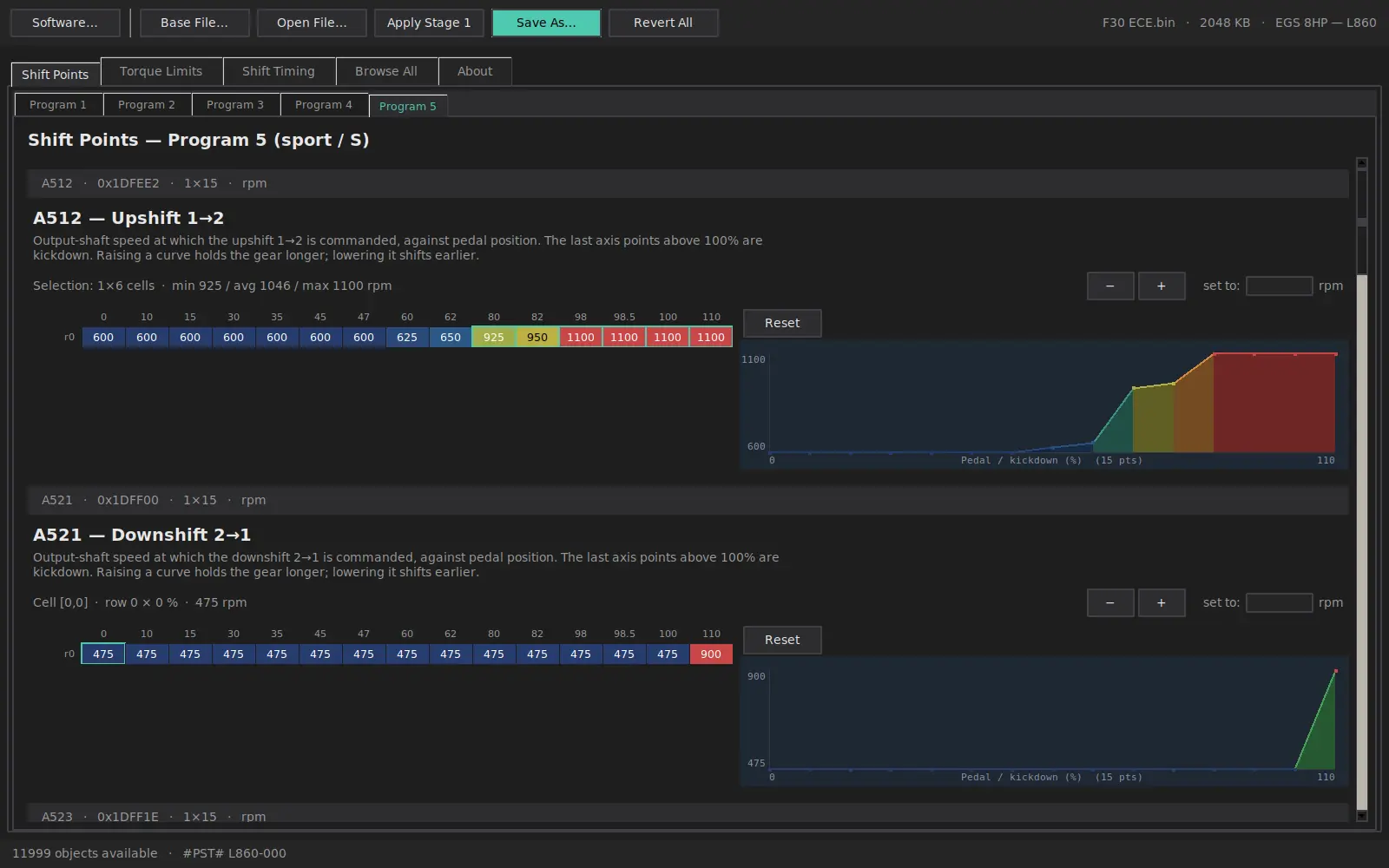
Sport program, 1→2 upshift. BMW short-shifts at 1100 rpm output — about 5200 engine.
Why the
gearbox matters
You can calibrate an engine perfectly and still lose the result at the gearbox. The EGS holds its own torque ceilings, and when a tuned engine exceeds them it asks the DME to pull torque — so the car goes soft exactly where the work went in. Then it upshifts before redline anyway.
Shift points
Hold the gear to redline
Every upshift and downshift curve, per program, against pedal position — including the kickdown region above 100%. Shown in output-shaft rpm the way the box works, and in engine rpm so the number means something.
Torque limits
The ceilings that pull timing
Gear-by-gear gearbox protection limits. This is the mechanism that makes a tuned car ask its own DME for less torque. Raise them knowingly, or leave them and understand why the car feels flat in the gears that matter.
Shift timing
Clutch fill and pressure
Fill and drain times per shift against fluid temperature and turbine speed, plus fast-fill pressure for all five shifting clutches and K0 — base, optimised and reduced. This is where shift feel actually lives.
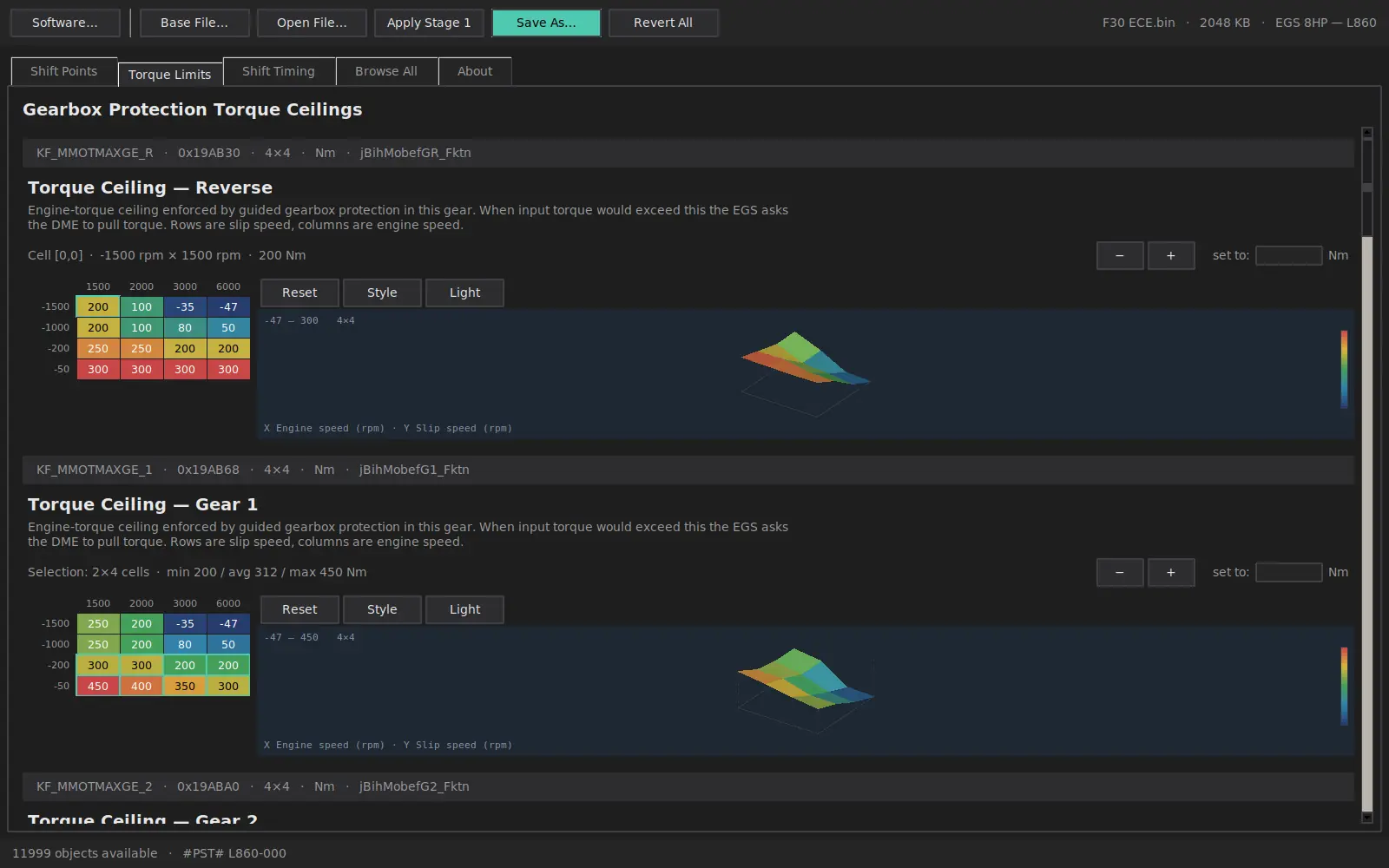
The guided gearbox-protection ceilings, gear by gear. This is what makes the EGS ask the DME to pull torque on a tuned car.
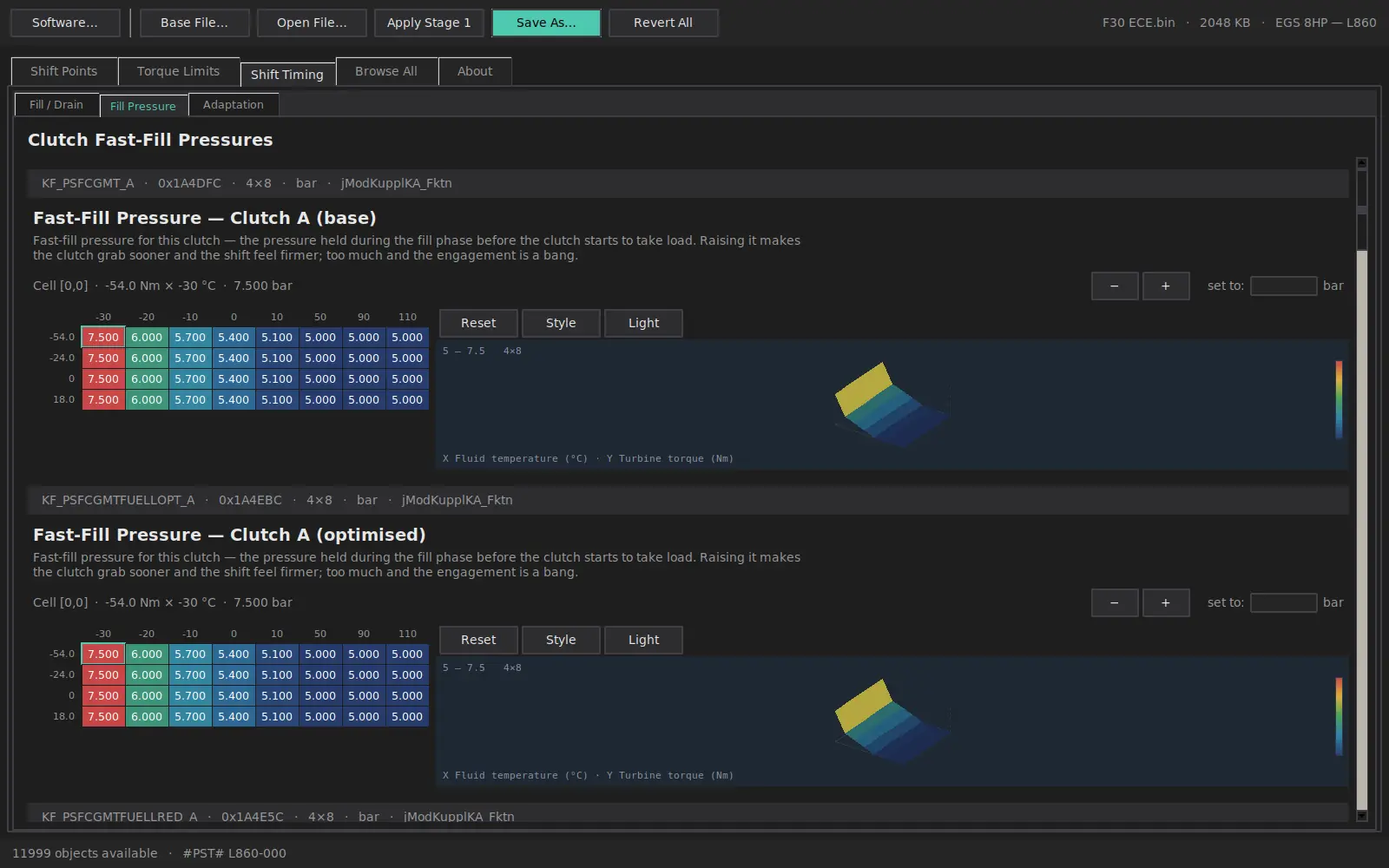
Fast-fill pressure for all five shifting clutches plus K0 — base, optimised and reduced.
Stage 1,
with the receipts
One button, but nothing hidden behind it. It tells you what it is about to change before it does anything, asks for the one number it cannot read out of the file, and then reports every object it touched — what it was, what it became, in engine rpm as well as raw.
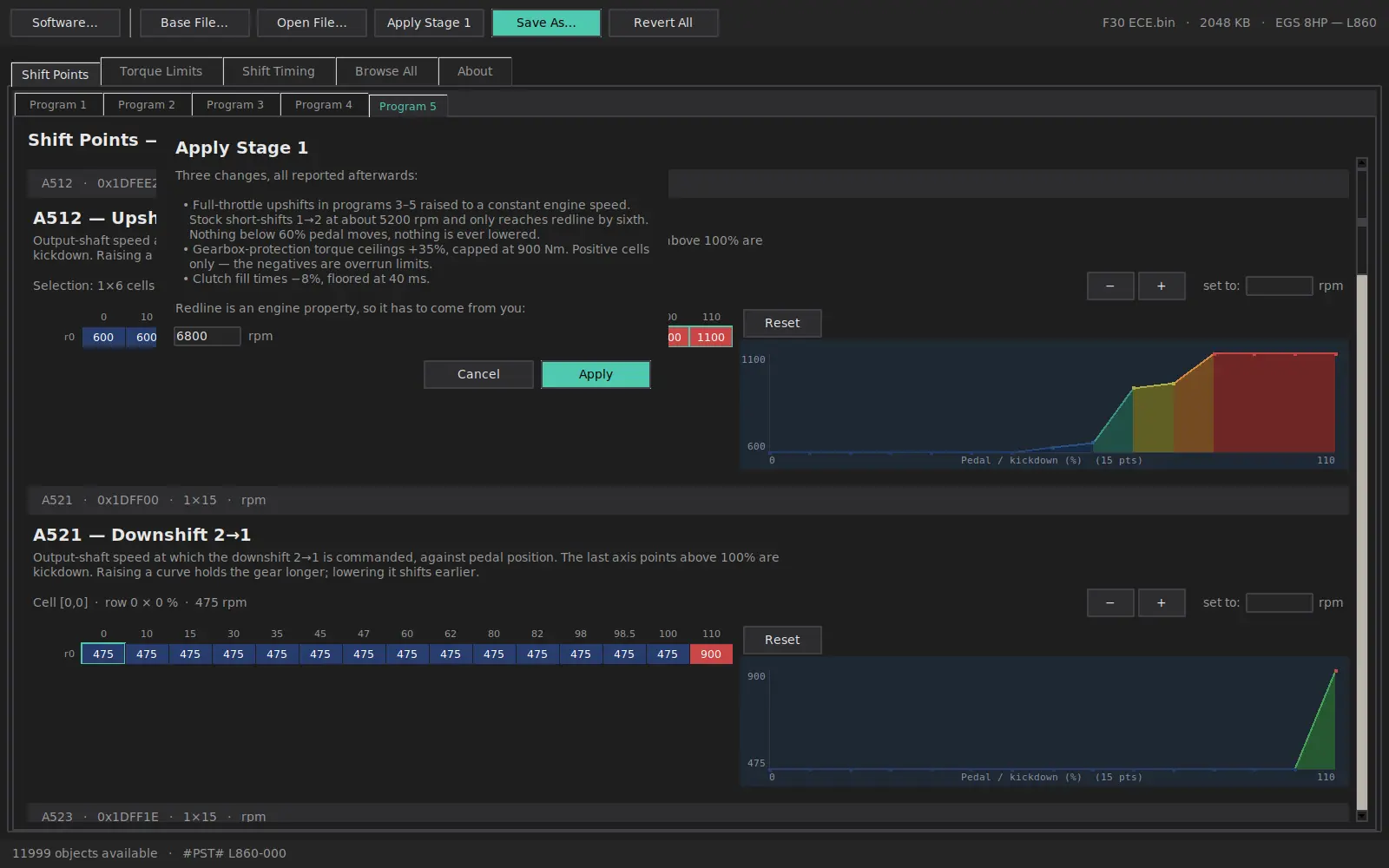
Stage 1 states what it will do before it does it, and asks for the one number the file can’t tell it.
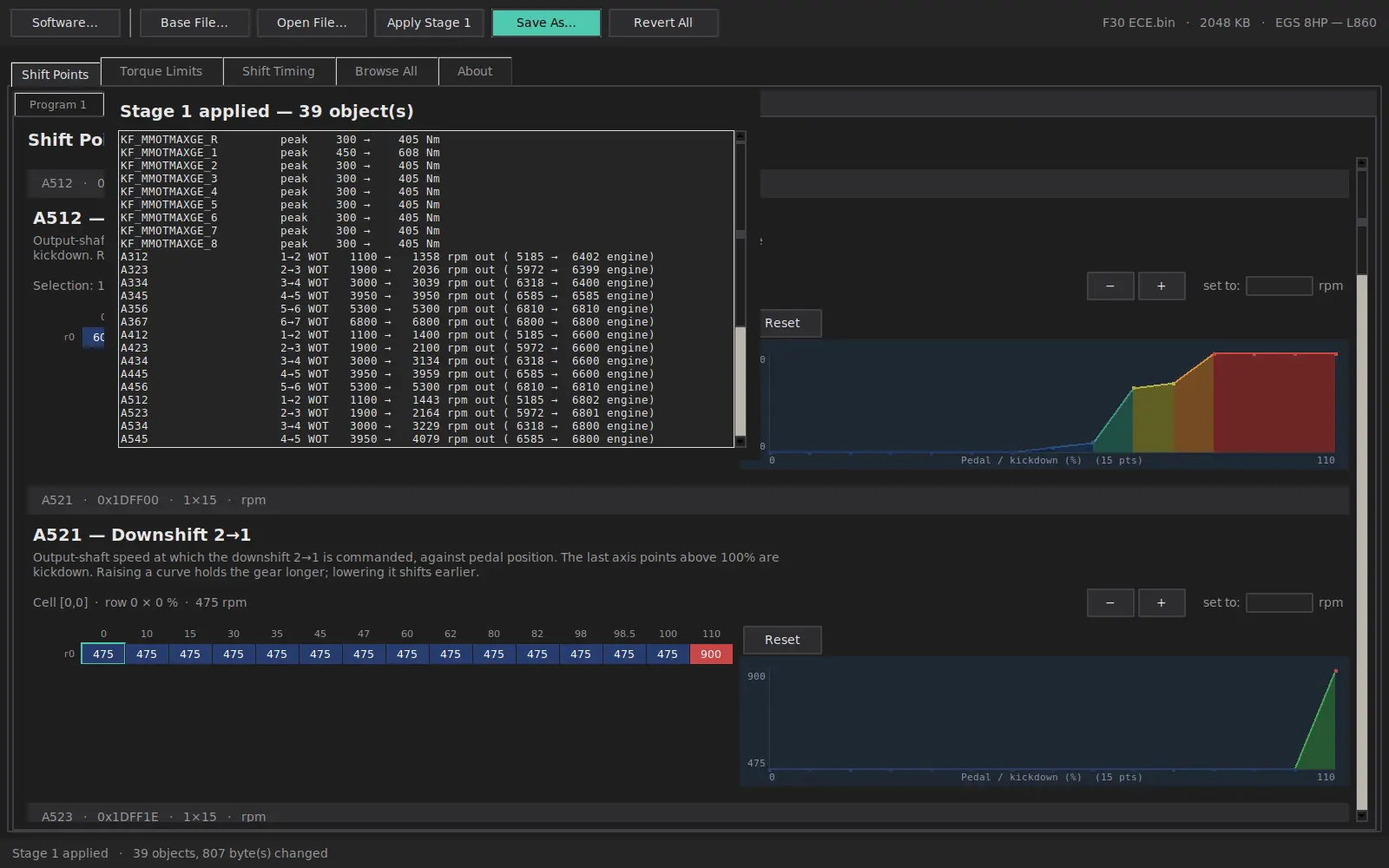
Every change reported: which map, what it was, what it became, in engine rpm as well as raw.
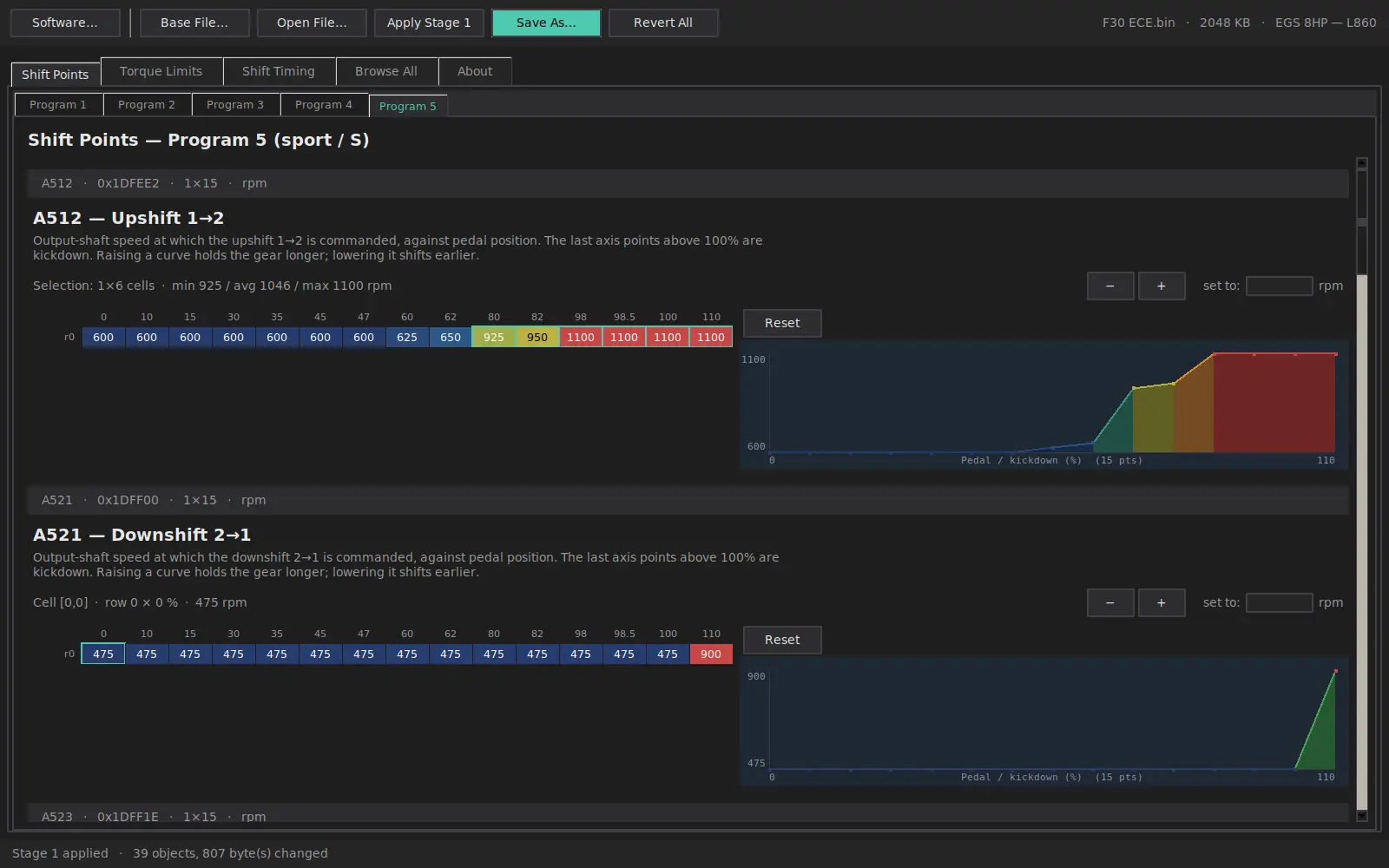
The same curve as the top of this page, now flat to 1443 rpm output — 6800 engine — from 60% pedal up. Nothing below that moved.
5185 rpm is where the factory upshifts 1→2 at full throttle. Stage 1 takes it to redline and leaves part-throttle shifting exactly as BMW set it, so the car still drives normally when you are not asking for anything.
Four lines,
one build
Each software line has its own addresses, its own axis lengths and its own verified definitions. The tool reads the #PST# tag out of whatever file you open and knows which one it is looking at, so there is no picking wrong and no guessing.
| Coverage | What that means |
|---|---|
| 57,090 | Calibration objects across the four lines, every one verified against its own factory image |
| 4 | Software lines — L860, 030B, Q590A, Q730A |
| 21 | Factory stock files included: F01 / F10 / F30 and Q590A / Q730A across ECE, US, CHN and Japan |
| 15,086 | Objects on the Q730A line alone, filterable by shape and searchable in German or English |
| Byte-identical | Round-trip verified on all 21 base images — read every object, write it back, nothing moves |
Round-trip byte-identical means the tool understands every object well enough to reproduce the factory file exactly. Anything less and you are trusting an editor that quietly changes things it did not mean to.
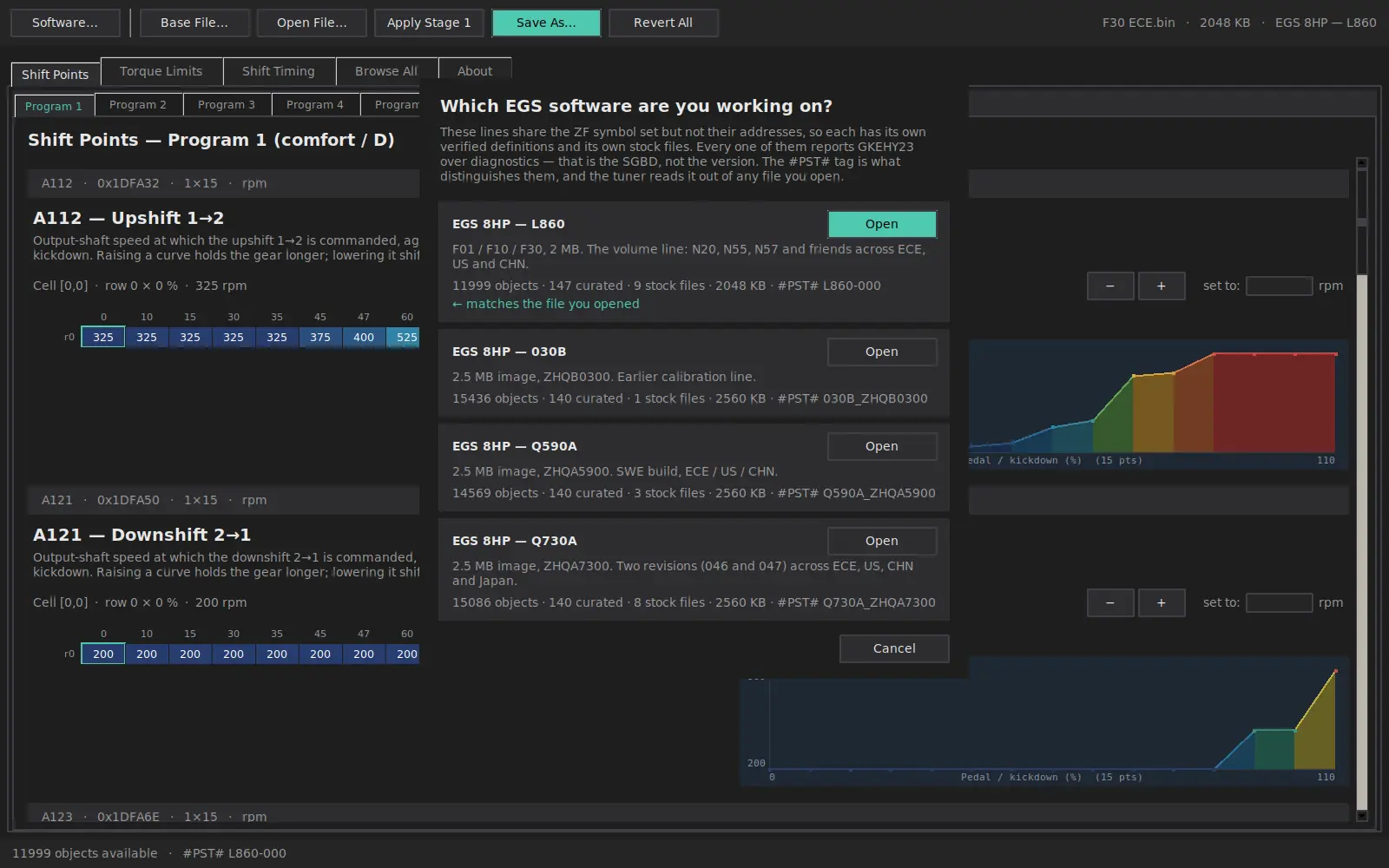
Four calibration lines in one build. The tool reads the #PST# tag out of any file you open, so it knows which one you are on.
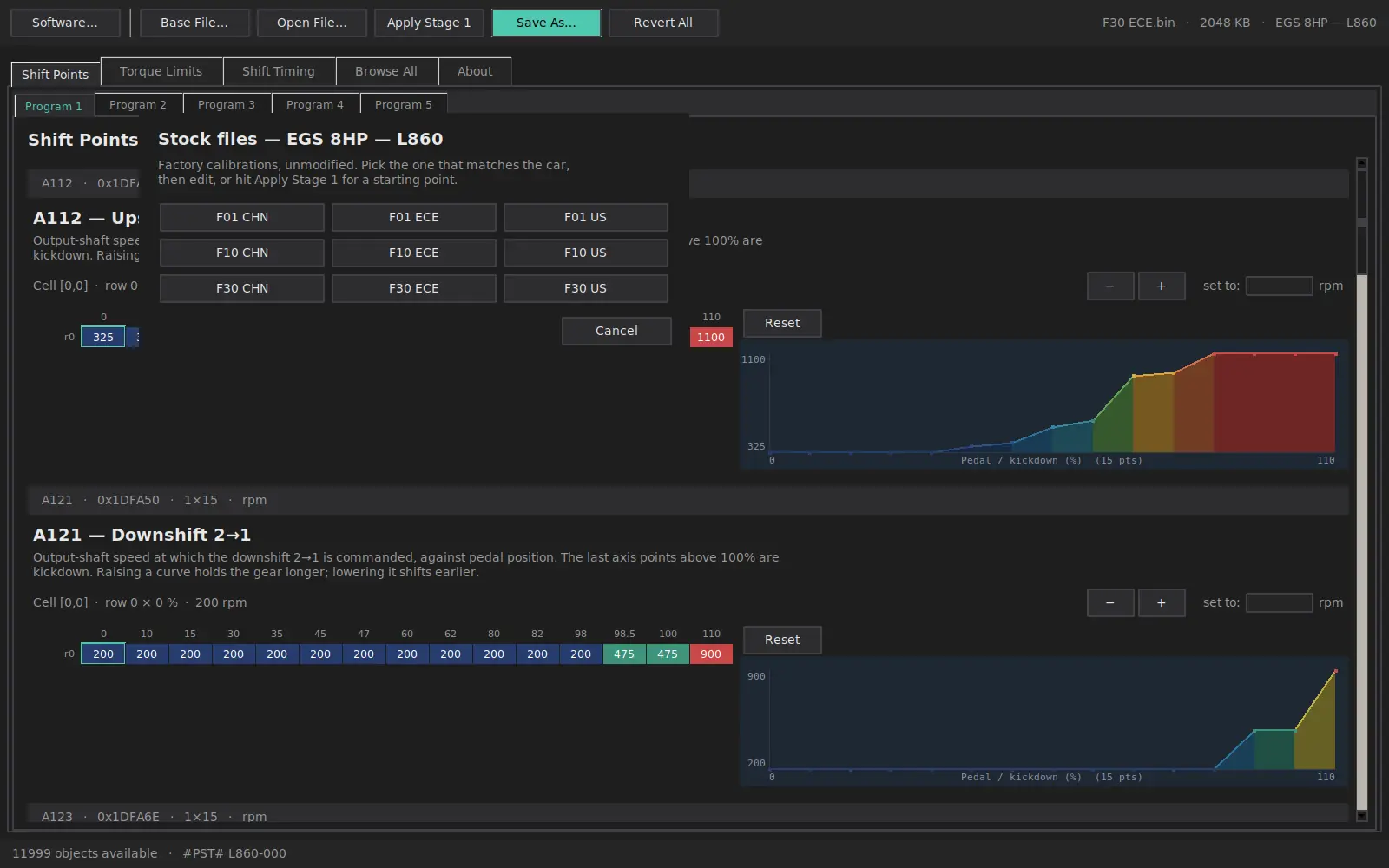
Factory calibrations for every chassis and region on the line, unmodified — so you always have somewhere clean to start from.
Curated tabs,
or all of it
The tabs cover what most people came for. Everything else in the factory A2L is still there and still editable — search matches the ZF symbol, the English label, the description and the ECU function, so you can find a map without already knowing what it is called.
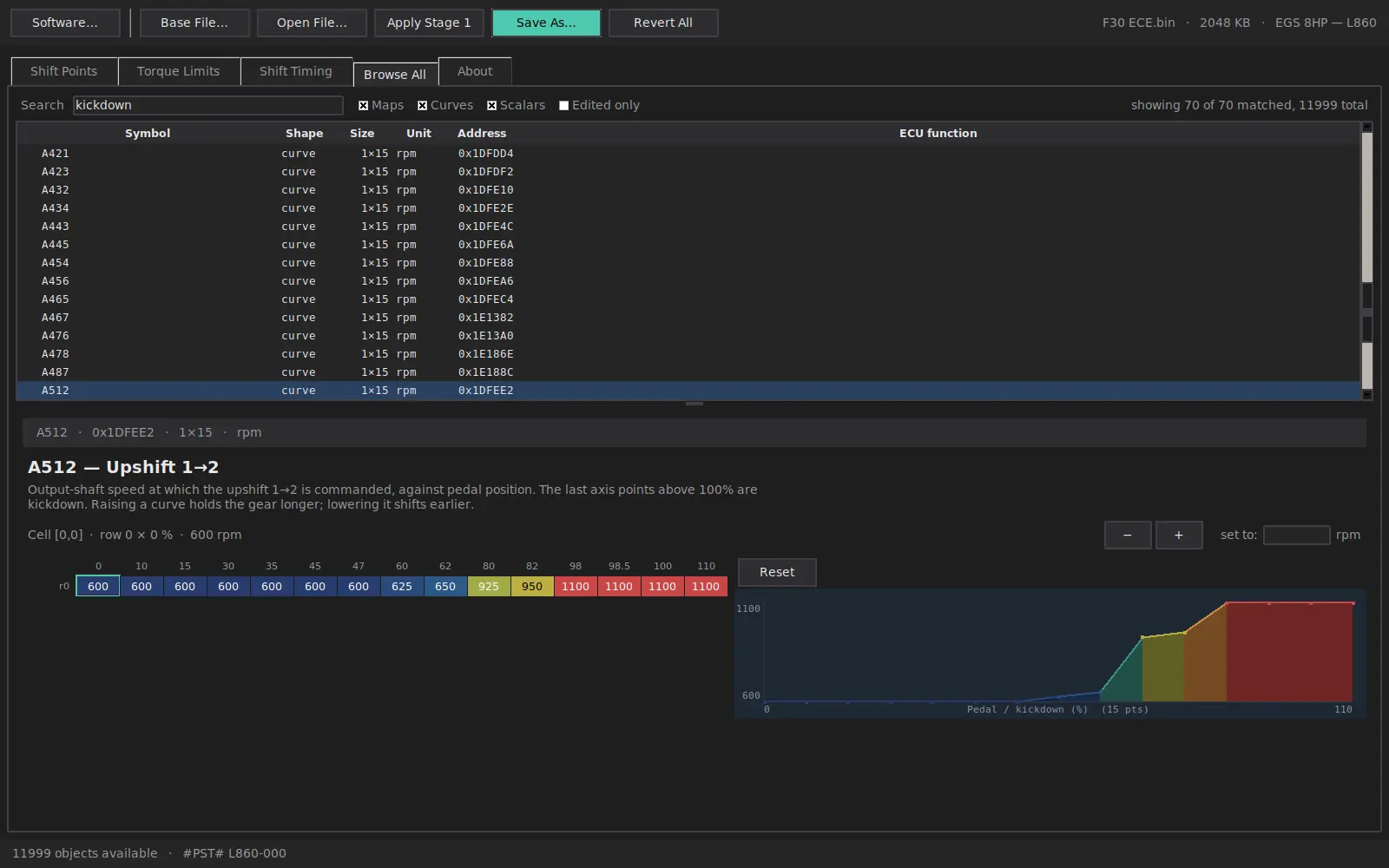
Search matches the ZF symbol, the English label, the description and the ECU function.
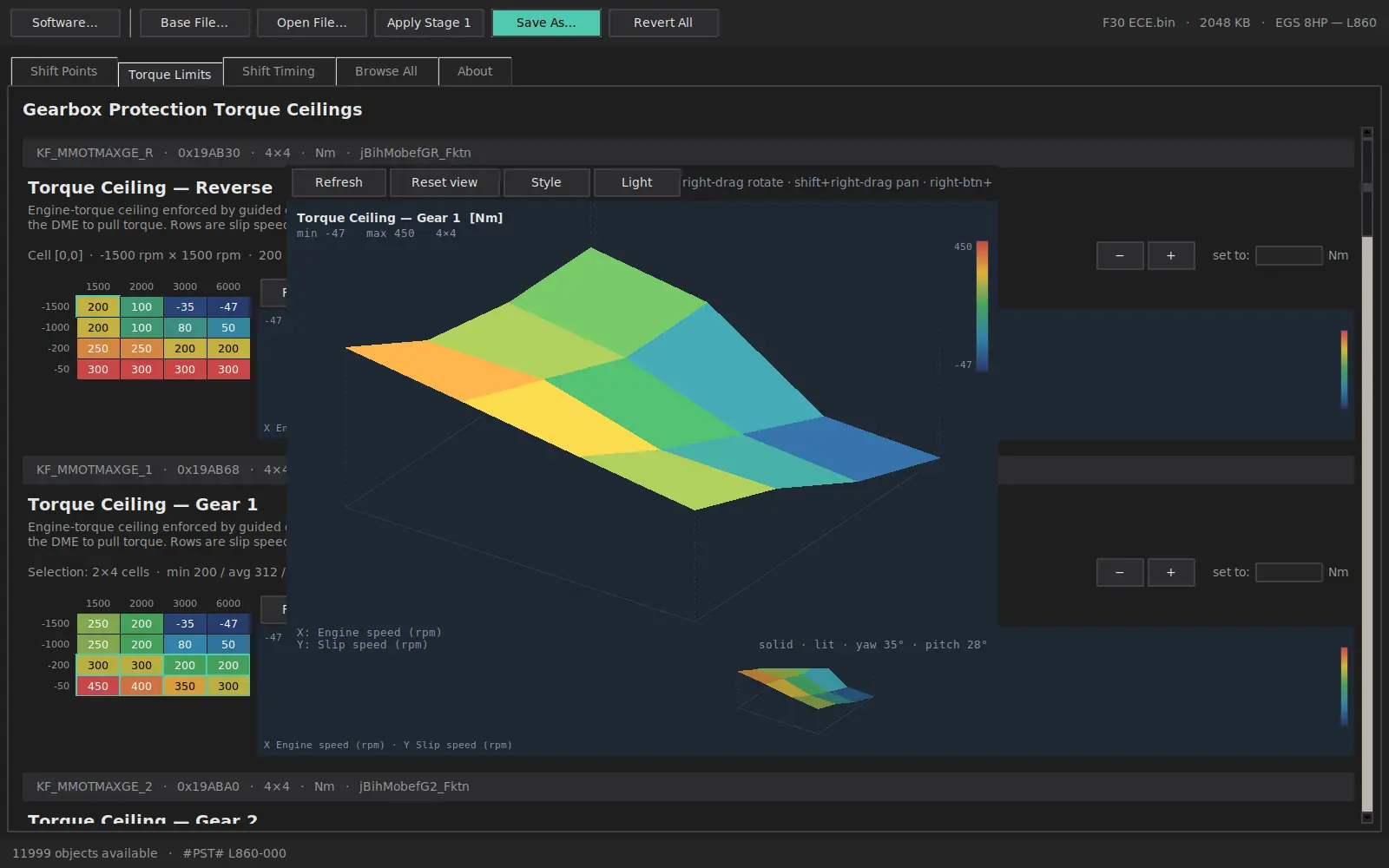
Any map pops out to a full surface, on the same heatmap as the table — the same editor as every other UGTuner platform.
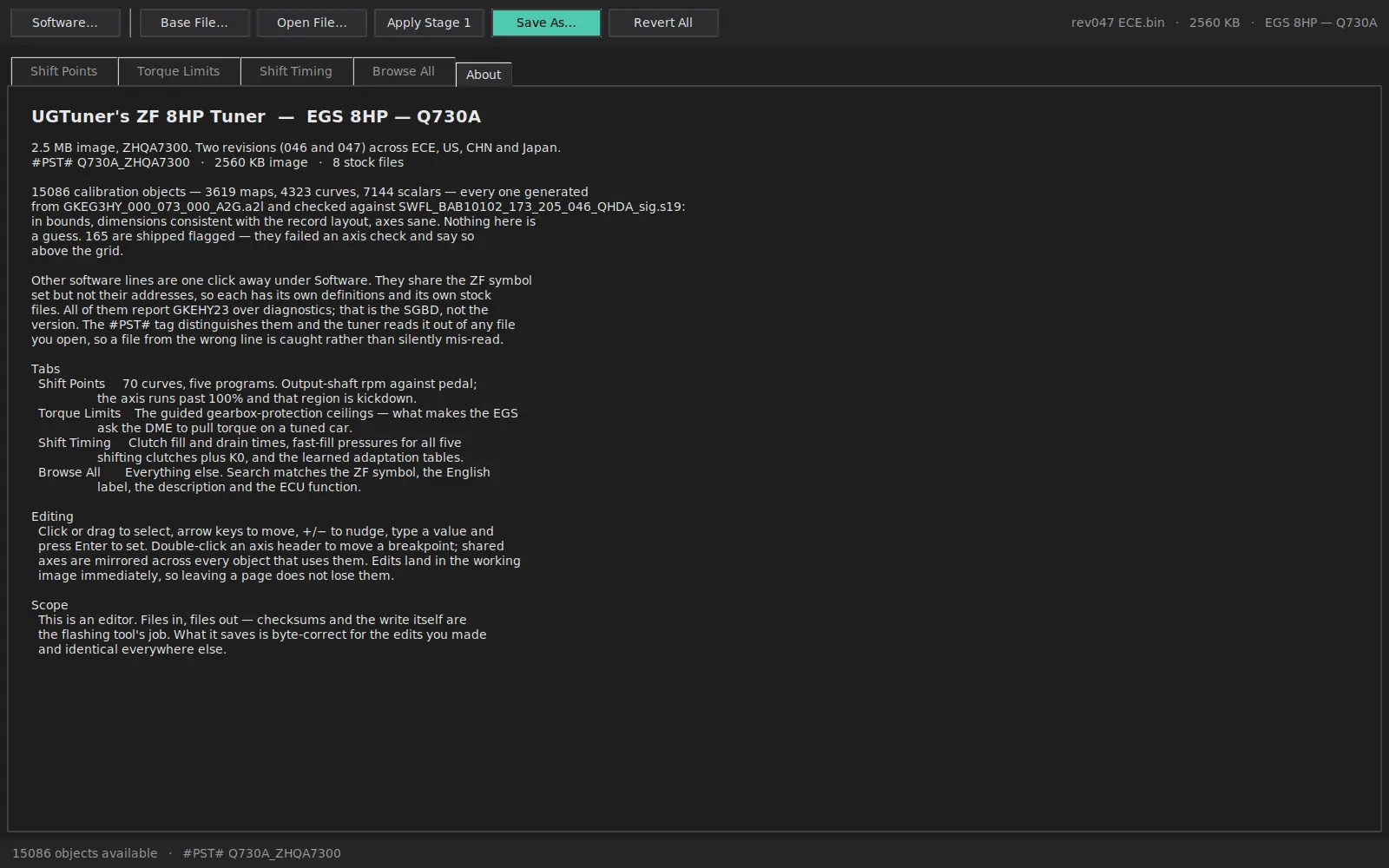
Provenance on the front page of the app: which A2L, which reference image, what was checked. You can see where the definitions came from.
Read this first
- This is a calibration editor. It opens a calibration file, lets you change it, and saves it again. It does not read or write the EGS — getting the file off the gearbox controller and back on is a separate job with separate tools, and you need one already.
- Keep the untouched original. Every stock file on the line ships with the tool, but keep your own read as well.
- Raising a torque ceiling removes a protection the gearbox was given for a reason. On a stock-power car there is nothing to gain by touching it.
- Clutch pressure and fill timing change what the clutches live through. Faster is not automatically better, and a shift that feels sharp on the road can be one that is wearing the box.
- Sold for off-road and competition use. What you do with it on a road car is on you.
Buy
Sold direct, by email. Say which suite you want — UGTuner ZF 8HP — and which chassis and EGS software line you are on, and I will send the file and the invoice.
ZF 8HP suite
$250
One-time, one PC
- All four EGS software lines in one build
- 21 factory stock files included
- Guided Stage 1 with a full change log
- Buy the platform once, tune as many cars as you like
- Updates and email support
Custom calibration
Contact
Quoted per job
- Built engines and big-power cars
- Converted or swapped gearboxes
- Shift feel worked to what you want
- Priced on what the job actually needs
Locked to one PC, not to one car. You send a hardware ID, I send back an activation
file — no internet check, no dongle, nothing phoning home.
Not sure which EGS software line you are on? You do not need to be — open the file and the tuner tells you. To check before you buy, send me the file, or the #PST# tag out of it — ugtperformanceusa@proton.me. Engine side too? The remote tuning page covers calibration work on the DME.